Executive Summary
- Halal compliance follows three basic stages: "Sourcing → Cooking Environment → Service Display".
- Required documentation and certification vary internationally; in Japan, utilizing guidelines is practical.
- Even small establishments can benefit from starting with partial compliance.
Definition and Necessity of Halal Compliance
Essential Assurance for Muslim Customers
Halal refers to food and practices that are "permitted" according to Islamic teachings. For Muslims, consuming halal-certified food is a religious obligation, not merely a matter of preference.
By implementing halal compliance, restaurants can provide peace of mind to Muslim customers, who represent approximately 25% of the world's population.
Domestic and International Inbound Demand
According to Japan National Tourism Organization (JNTO) statistics, tourists from Southeast Asia and the Middle East are increasing annually. Particularly, many tourists from Malaysia, Indonesia, UAE, and Saudi Arabia are Muslim, creating growing demand for halal-compliant restaurants.
Role of Certification Systems and Guidelines
In Japan, certification bodies such as the Japan Islamic Trust (JIT) and Malaysia‑Pakistan‑Japan Friendship Association (MPJA) exist. However, since certification acquisition requires time and cost, starting with compliance based on guidelines from the Ministry of Agriculture, Forestry and Fisheries and Ministry of Land, Infrastructure, Transport and Tourism is realistic.
Step 1: Sourcing
Selection of Halal-Certified Ingredients and Seasonings
Essential Compliance Items
- Meat: Use of halal-certified beef, chicken, and lamb
- Seasonings: Alcohol-free soy sauce, mirin, and vinegar
- Oils: Vegetable oils or halal-certified animal fats
- Additives: Elimination of prohibited ingredients like pork-derived gelatin
Supplier Verification and Documentation Methods
Certificate Verification
Obtain copies of halal certificates from suppliers and verify expiration dates
Ingredient List Review
Check all ingredient and additive lists for prohibited components
Regular Updates
Regularly verify certification renewal status and maintain records
Step 2: Kitchen and Cooking Environment
Cross-Contamination Prevention with Non-Halal Ingredients
Equipment and Utensil Separation
- Knives and cutting boards: Complete separation between halal-dedicated and non-halal dedicated
- Pots and pans: Clear distinction through color coding or label display
- Dishes and serving plates: Use of dedicated dishes or thorough cleaning
Oil and Cooking Liquid Management
- Frying oil: Use halal-dedicated oil, prohibit mixing with oil used for pork
- Soup and broth: Prohibit use of pork bone broth, utilize kelp and bonito broth
Kitchen Layout and Practical Checklist
Refrigerator and Storage Separation
- ✓ Install dedicated refrigerator or dedicated shelves for halal ingredients
- ✓ Store in sealed containers with thorough labeling
- ✓ Physical separation from pork and other prohibited ingredients
- ✓ First-in-first-out inventory management system
Cooking Procedures and Hygiene Management
- ✓ Thorough hand washing and utensil cleaning before halal cooking
- ✓ Cooking sequence management (halal → non-halal order)
- ✓ Cross-contamination prevention checks during cooking
- ✓ Proper storage and serving methods for finished products
Step 3: Service and Display
Menu Labeling Methods
Recommended Display Examples
- • "Halal Certified Kobe Beef Steak"
- • "Halal Certified Kobe Beef"
- • "حلال معتمد لحم بقر كوبي" (Arabic)
- • Include halal mark (🌙)
It's important to clearly indicate halal compliance on menus in Japanese, English, and Arabic, and use visually recognizable marks.
Classification of Full Compliance vs. Partial Compliance
Full Compliance
Meets halal standards in all processes and has obtained certification
Partial Compliance
Uses halal ingredients with cross-contamination prevention measures
Please Inquire
Please ask staff for detailed compliance status
Rules for Storefront, Website, and Certification Mark Usage
Storefront Display
- • Post halal compliance notice near entrance
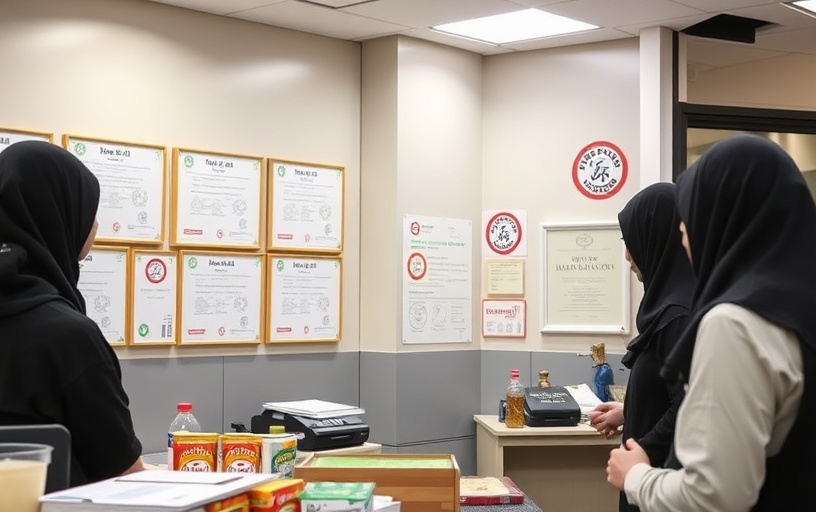
- • Display copies of certificates in visible locations
- • Multilingual signage
- • Prayer space guidance (when available)
Website and Social Media
- • Create halal compliance page
- • Clearly state certification body name and number
- • Detailed explanation of compliance level
- • Establish pre-consultation window for reservations
Implementation Costs and Phased Approach
Simple Measures Before "Certification Acquisition"
Phase 1: Basic Compliance (Monthly Cost: $200-350)
- • Partial introduction of halal-certified ingredients
- • Purchase and color-coding of dedicated cooking utensils
- • Basic staff education
- • Addition of halal labeling to menu
Equipment Renovation and Staff Training Cost Estimates
Initial Investment
- Dedicated cooking utensils: $700-1,400
- Refrigerator separation equipment: $350-1,050
- Signage and display creation: $200-550
- Staff training: $140-350
Total: $1,390-3,350
Monthly Operating Costs
- Halal ingredient premium: $140-280
- Certification maintenance: $70-140
- Additional labor costs: $70-210
- Management and record keeping: $35-70
Total: $315-700/month
Certification Costs
- JIT certification: $2,100-3,500
- MPJA certification: $1,400-2,800
- Annual renewal fee: $350-700
- Audit costs: $210-550
First year: $4,060-7,550
Benefits of Partial Compliance for Small Establishments
Business Benefits
- • Develop new customer segments (Muslim tourists and residents)
- • Increase average customer spending (premium pricing possible)
- • Differentiation from competitors
- • Capture inbound demand
Operational Benefits
- • Reduce operational burden through phased implementation
- • Staff skill development
- • Improve ingredient quality
- • Enhance hygiene management standards
Common Misconceptions and FAQ
Q: Do I need to change the entire menu?
A: Partial compliance is possible. You don't need to make your entire menu halal-compliant. You can start by making some popular menu items halal-compliant and offering them as a separate "Halal Menu." Many establishments gradually expand their compliance scope.
Q: Are all imported seasonings prohibited?
A: It depends on the certificates. Many imported seasonings have obtained halal certification. The key is to obtain halal certificates from manufacturers and verify ingredient lists. Particularly for soy sauce, mirin, and vinegar, halal-certified alternatives are available.
Q: Is certification absolutely mandatory?
A: In practice, you can start with guideline compliance. While formal certification is ideal, you can begin with compliance based on guidelines from the Ministry of Agriculture, Forestry and Fisheries and Ministry of Land, Infrastructure, Transport and Tourism. A realistic approach is to gradually work toward certification while building customer trust.
Summary
Sourcing
Selection of halal-certified ingredients and certificate management
Kitchen
Cross-contamination prevention and cooking environment setup with dedicated equipment
Display
Multilingual menus and clear display of certification status
Steady compliance is possible through the three stages of sourcing, kitchen, and display. A realistic approach is to implement gradually and expand according to increasing demand. Rather than aiming for perfection, taking the first step is important.
Notice from Lupina Corporation
Differentiate Your Restaurant with Halal Kobe Beef
We provide Japan's only halal-certified Kobe beef to restaurants. Deliver special experiences to Muslim customers with the highest quality ingredients.
Learn More